10th September 2025
Written by Georgina Bowyer, UKSPF Grants Manager, Capital City Partnership

Wilson Memorial Church
Over the next few months, several community-based projects in Edinburgh will benefit through capital investment from the UK Shared Prosperity Fund (UKSPF). This is the fourth and final year of UKSPF, which was brought in by UK Government in place of European Structural Funds following Brexit.
Following confirmation of this year’s UKSPF allocation to City of Edinburgh Council, councillors agreed that in order to make effective use of the budget within the short 12-month window for spend, the majority of the money should be used to support applications that had come through the Place Based Investment Programme (PBIP) process. This Scottish Government fund provides support and co-ordination for regeneration that is shaped by the needs and aspirations of local communities. PBIP aims to promote economic recovery and tackle inequality, objectives which complement the overarching aims of UKSPF.


The City of Edinburgh Council had an application process in place for the fifth and final year of PBIP through which local community organisations were invited to apply. When UKSPF capital funds were confirmed for 2025-6, applications for PBIP had already been assessed and scored and the PBIP was oversubscribed. Therefore, priority projects that could be completed before the March 2026 deadline were approached with the offer of UKSPF funding in lieu of PBIP funding. As a result, the following projects will receive UKSPF capital funds and are swiftly moving ahead to undertake the work:
Joining up the processes and budgets available from these funding streams means that capital budget can now be used to support projects brought forward by the community, despite the short timescales for spend. Project leads are now working hard to turn these ideas into reality. In each case the work represents not just an improvement to a physical space particularly valued by local people, but also the enabling and enhancement of activities which are bringing the community together. We look forward to seeing the positive impacts of these projects in the months and years to come and hope to share updates and photographs here on the UKSPF blog in due course.
Want to know more about UKSPF funded Edinburgh projects? Visit our UKSPF webpage.
Don't miss an update, subscribe to our blog!
20th August 2025
Written by Heather Yang, Core Services Manager, Volunteer Edinburgh
Volunteer Edinburgh exists to build strong social connections, reduce inequalities and support vibrant communities through volunteers and volunteering activities. This work is delivered through a series of different programmes, one of which is Local Volunteering Gateways, funded through the UK Shared Prosperity Fund.
Local Volunteering Gateways engages local partners in each of the four localities of Edinburgh to develop a holistic programme of gateway opportunities, formal volunteer opportunity development, and capacity building. The team includes Will Toms, the Volunteering Development Officer for Northeast Edinburgh, who is regularly based in Craigmillar, Portobello, Restalrig, and Craigentinny to meet people and help find the right volunteering opportunity for them. Natalie Lyons Ballantine is the Volunteering Development Officer in the Northwest and Southwest of Edinburgh. She has experience in supporting and developing opportunities for volunteers and employees across a variety of roles.
The team have been incredibly busy this year as they gain recognition in local communities. They have expanded their drop-in sessions throughout Edinburgh and the number of referrals is on the rise, thanks to their reputation for providing a trustworthy and high-quality service that encourages individuals of all ages to take their first steps into volunteering.


People have had the chance to explore a variety of activities, from gardening to new roles at places like Lauriston Castle, St Giles Cathedral, and Street Soccer. There has been a surge of exciting new opportunities for those looking to volunteer, with the team actively working on creating diverse options that are both fulfilling and rewarding.
Will and Natalie are always ready to assist Volunteer Involving Organisations (VIOs) and individuals interested in volunteering. You can find details about drop-in locations and activities on the Local Volunteering Gateways website here or Facebook page here.
Want to know more about UKSPF funded Edinburgh projects? Visit our UKSPF webpage.
Don't miss an update, subscribe to our blog!


8th July 2025
The drive to reduce our impact on the environment around us is a key priority for us as a society if not as a planet, and it is a theme that filters through many facets of life and work. Reducing emissions and improving our environmental practices is at the core about humanity’s long-term survival, but these priorities also offer opportunities to do business in a more efficient way, reduce costs, and create new and better jobs on a regional and national scale.
This is why we at Capital City Partnership increasingly find ourselves connecting with the net zero agenda as we carry out our work in employability, skills and poverty prevention. To mark Net Zero Awareness Week this July, we are sharing a snapshot of our climate related work and highlighting the important work of many of our partners on this.
Edinburgh
Edinburgh and South East Scotland Region
Under the Regional Prosperity Framework, Capital City Partnership has commissioned a range of projects focused on accelerating the transition to Net Zero across Edinburgh and South East Scotland. These include:
West Lothian College successfully delivered a feasibility study for a Net Zero Accelerator Hub (NZAH), co-authored with the University of Edinburgh. This comprehensive report laid the groundwork for a regional hub by conducting detailed skills mapping, early-stage planning, and strategic development, with valuable contributions from West Lothian, Borders, Edinburgh, and Fife Colleges.
Architectural plans and designs for future training facility expansions were developed by Fraser Livingston Architects. The study also drew on a wider regional analysis led by Fife Council and funded by Innovate UK, which examined projected Net Zero activity across all six local authorities in the City Region. The feasibility study marks a significant step toward realising the region’s Net Zero ambitions through collaborative and strategic action.
Led by The Verdancy Group, a three phase assessment project was commissioned to evaluate the current skills landscape to identify critical gaps and develop actionable strategies to equip the workforce with the necessary competencies. Through extensive collaboration with industry experts, educational institutions, and policymakers, the project aligned training programmes with national policies like the Local Heat and Energy Efficiency Strategies (LHEES).
Additional Projects Across the Edinburgh and South East Scotland Region:
The journey to net zero represents not only a serious challenge for the coming years but also an opportunity to live and work in a way that delivers increased benefits for both people and planet. We are excited to be working with partners to maximise that potential and would welcome conversations with other interested parties working in the City of Edinburgh or wider city region.
Want to know more about UKSPF funded Edinburgh projects? Visit our UKSPF webpage.
Don't miss an update, subscribe to our blog!
30th June 2025
Written by Georgina Bowyer, UKSPF Grants Manager, Capital City Partnership
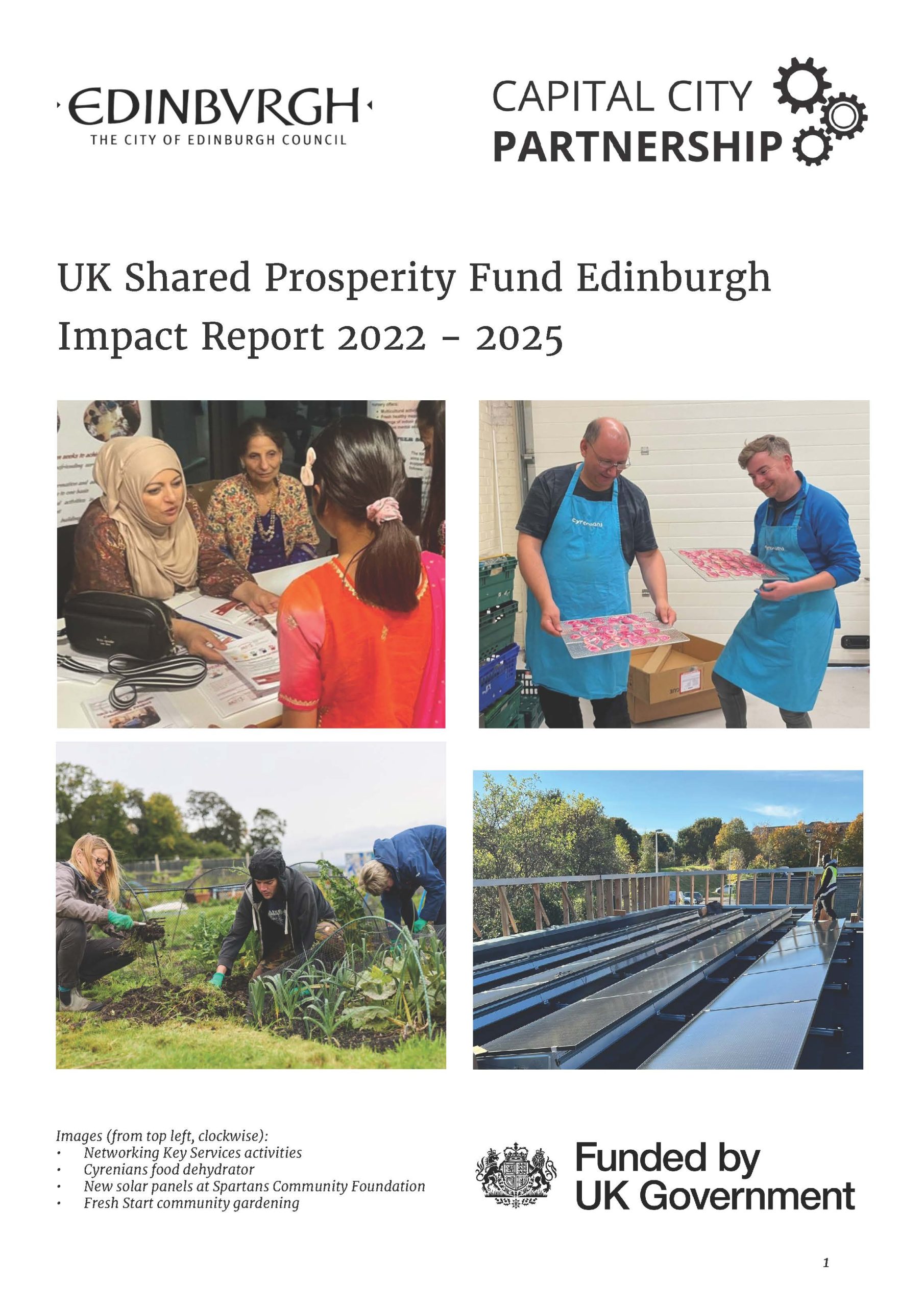
A report highlighting the impact of the UK Shared Prosperity Fund (UKSPF) in Edinburgh over the first three years of the programme has been published today.
UKSPF was introduced by the UK Government in 2022 for a committed period of three years. Between 2022 and 2025, UKSPF provided £12.3 million to the City of Edinburgh, which was divided across the thematic priorities of Community and Place, People and Skills, Supporting Local Business, and Multiply (a specific initiative to improve adult numeracy).
UKSPF has since been extended for an additional financial year between April 2025 and March 2026. The UK Government’s Spending Review of June 2025 indicates that the fund will then transition to two new programmes focusing on local growth and deprived communities.
Today’s report shares final statistics from the three-year phase, drawn from the UK Government monitoring data, alongside some brief narrative reflections. Edinburgh has also been selected as one of the case studies for the UK-wide evaluation commissioned by UK Government and carried out by Ipsos. The Ipsos evaluation will offer more by way of contextualising the impact of the programme using local data to assess change and including some deep-dive case studies.
In the meantime, this summary report showcases the broad impact of UKSPF in Edinburgh across a wide range of themes, including that 52 neighbourhood improvements have been made and 160 trees planted; 1,371 businesses have received support, and 221 new businesses have been created; and 3,363 people have received support for the purposes of employability, to develop life skills or to obtain welfare advice.
The video summarises the headline outputs and outcomes from across the three-year phase. You can also read the report UKSPF Edinburgh Impact 22-25 - Final here. (PDF, 8 pages).
Want to know more about UKSPF funded Edinburgh projects? Visit our UKSPF webpage.
Don't miss an update, subscribe to our blog!
5th June 2025
Written by Jessie Colligan, UK Shared Prosperity Fund Programme Administrator
We're delighted to announce the launch of Forever Edinburgh’s new campaign, Stay Different, which is part-funded by the UK Shared Prosperity Fund. The Stay Different campaign uses visuals, videos, and written content to encourage visitors to stay longer in the city and surrounding areas.
It is designed to encourage visitors to discover the wealth of attractions available at different times of year, and to showcase the opportunities that appeal to a range of different personalities and interests. The grant also supports the development of material to increase the inclusivity of Forever Edinburgh's outreach.
The campaign was launched with a new film and a dedicated microsite bursting with inspiration and fresh ideas celebrating the city’s diverse offerings.
You can watch the videos here and find out more about Stay Different here.
#StayDifferentEdinburgh
Want to know more about UKSPF funded Edinburgh projects? Visit our UKSPF webpage.
Don't miss an update, subscribe to our blog!

Written by Anja Kirchhof, Senior Associate, Challenges Group
The first phase of the UK Shared Prosperity Fund ran from 2022 – 2025, concluding in March. The UK Government confirmed a continuation year which ensures consistency for the programme until March 2026. One of the funded projects in Edinburgh was Making Work Work, run by the Challenges Group. Making Work Work supports professional women who have taken time out of the labour market, to return to work. In this blog, Challenges Group Senior Associate Anja Kirchhof reflects on the last two years of delivery.
Between April 2023 and December 2024, the Challenges Group supported 96 Edinburgh women through the Making Work Work – for Edinburgh Women programme. The programme consists of a 6–8-week online training programme with a holistic wrap-around service of masterclasses, mentoring, peer support, and curated self-study.
In addition, the team supported 250 women through outreach and signposting, and a further 9 women through the LEAP (Learning, Employability, and Purpose) programme which included a 6-week work placement.
Within the Making Work Work programme suite, the team work with women who have had a career break for any reason. Typically, women take breaks for maternity, childcare, elderly care, health reasons, redundancy or relocation. Through collaboration with UKSPF, CCP and CEC, Making Work Work has been able to support women who are currently on their career break, as well as those who have returned to work beneath their skills, availability or earning potential, who are “underemployed”.
Learnings that have come out of working with this cohort are that women with management experience or aspirations, who are typically well-educated and skilled, face several barriers to employment. They often face bias or discrimination based on motherhood, age, caring responsibilities or their CV gaps. However, these women are highly educated and have rich work and life experiences, often coming from different countries and cultures, and speaking more than one language. They are keen to learn, keen to work and often keen to pursue careers with social or environmental impact.
Participants thrive through the peer-support experience throughout the programme. By using the tools and learning provided, many of them are successful in moving into work or progressing in work to roles more aligned with their skills and values, while also increasing their income.
Helen: “[They] decided I wasn't the right fit for the Account Manager job I interviewed for, instead they wanted to put me forward for the Senior Account Manager role! [...] a fantastic permanent job offer [...], which I've just accepted. [...] Thanks again for everything - I can't believe I'm going back into work with a promotion!”
Poppy: “Poppy: “I got the 32 hour position and have been getting settled into this new position over the last 3 weeks. I really enjoyed the interview experience of which MWW programme gave me notable confidence. I secured set days for myself, which was a win as it is a rota with shifts.“
The Making Work Work programme is receiving further funding through the UK Shared Prosperity Fund for 2025/2026 and is continuing to provide training to women in Edinburgh. The latest cohort began in May. To find out more about the programme, you can visit the Making Work Work website.
Want to know more about UKSPF funded Edinburgh projects? Visit our UKSPF webpage.
Don't miss an update, subscribe to our blog!
Written by Jessie Colligan, Capital City Partnership, UK Shared Prosperity Fund Programme Administrator
Community gardening offers numerous benefits to individuals and local communities, including increased access to fresh and healthy food, improved health and wellbeing, enhanced biodiversity, reduced carbon emissions, decreased food waste, and strengthened local economies.
This National Gardening Week, we’re celebrating the community gardening projects continuing to deliver work in Edinburgh through the UK Shared Prosperity Fund.
Edible Estates


Growing Together is a collaborative project run by Edible Estates aimed at developing and supporting community gardening and food growing across Edinburgh. It is supported by UKSPF and through the City of Edinburgh Council’s community gardening framework.
Growing Together supports neighbourhoods and local organisations to set up new community gardens, improve existing gardens, and get more people involved. Working with local people, they build and repair community garden spaces, assist with planting and gardening, and help to create sustainable community organisations that provide spaces and activities that positively impact the wider community. The impact of the work includes enhancing individual health and wellbeing, bringing neighbourhoods together, and creating more beautiful and biodiverse spaces to enjoy.
The nine neighbourhood gardens that have been supported by UKSPF funding are:
Neighbourhood gardens are built primarily by residents volunteering at workshops led by community gardeners.
Fresh Start

UKSPF supports several areas of Fresh Start's work, including their growing spaces. Fresh Start has four community gardens in Edinburgh at Inchgarvie Court, Craigmillar, Lauriston Farm, and Ferry Road Drive.
One participant said “I love being at the garden. It has boosted my confidence and taught me to be more comfortable in a group. Adrienne’s leadership is amazing and I feel totally safe in the space”.
Another participant said “I've met some lovely people, learnt new skills and felt part of a team. The group is led by the wonderful Adrienne, who makes everyone feel welcome and comfortable. She directs us towards tasks needing done but happily takes on suggestions from us too resulting in a supportive, collaborative dynamic. Tea break is always a highlight - often with stories and laughter - but it's also a time when folk from different walks of life can come together, drink tea, chat or sit quietly, and enjoy the company of each other.”
Empty Kitchens Full Hearts


Empty Kitchens Full Hearts has an existing core service delivery of turning surplus food into meals that are delivered to those in need across Edinburgh. UKSPF funding supports a volunteer coordinator who has overarching responsibility for the recruitment and coordination of volunteers across all areas of the organisation.
Volunteers grow fruit and vegetables which the team use in meal packs and offer to people to take away with them after the community lunch on Fridays. Volunteers have also been planting flowers in the beds in the garden and around the front of the building, which has brightened the place up and makes the garden welcoming. Due to the improvements within the garden, the project has hosted various events such a community BBQs and community lunches in the garden for volunteers and local service users to enjoy the space together.
You can find out more about the work supported by UKSPF in Edinburgh using the links below:
To read more about Edible Estates here.
To read more about Fresh Start here.
To read more about Empty Kitchens Full Hearts here.
You can also find out more about National Gardening Week 2025 here.
Want to know more about UKSPF funded Edinburgh projects? Visit our UKSPF webpage.
Don't miss an update, subscribe to our blog!

Through our work with the Edinburgh and South East Scotland City Region Deal's Intensive Family Support Service at Capital City Partnership, we have spent the past year collaborating with families and organisations across the region to address a challenge that often goes unnoticed: poverty-related stigma. This issue goes beyond material deprivation, deeply affecting people's dignity, self-esteem, and how those in poverty are viewed and treated in society.
As Ruth Lister, Professor Emerita of Social Policy, put it:
________________________________________
"Poverty is not just about a lack of resources, it is also about shame and stigma, the daily humiliations that people experience."
________________________________________
Parents and young people shared that poverty-related stigma is experienced daily within their communities. Harmful stereotypes, judgmental attitudes, and discriminatory practices affect how people access support, contributing to their isolation and marginalisation.
Change the Story: Co-Designed by Families
To tackle the issue of poverty-related stigma, we developed Change the Story through a co-design process that actively involved families affected. Over 30 families, including parents and young people, shared their personal experiences of stigma. These experiences shaped the Commitment, ensuring that its principles of dignity, equality, and inclusivity are grounded in reality.
We collaboratively developed a set of actionable principles and guidelines to help organisations fully understand the scope of the issue and take proactive steps towards mitigating stigma. Signing the Change the Story Commitment shows dedication to addressing and reducing the stigma associated with poverty that many people experience, particularly those who rely on support services. It is designed for anyone working to support individuals and families, including practitioners, project staff, community, and statutory organisations.
Fife’s Stigma Toolkit
Change the Story was inspired by the experiences of families in Fife, Scotland, working with the Making it Work for Families Project to create a practical Stigma Toolkit. Developed in partnership with The Poverty Alliance, the toolkit offers concrete tools and strategies to combat stigma and enhance support practices. This resource is being rolled out across Scotland alongside the Commitment, providing tools for organisations to address stigma at its roots.
Why Stigma Matters
Stigma can involve negative assumptions, prejudice, and discrimination. Stigma is often rooted in moral judgements about what is wrongly assumed to be a choice. It can lead to discrimination, marginalisation, and the unjust treatment of individuals based on characteristics such as race, gender, sexuality, health, or wealth.
For many people, the shame and embarrassment tied to being poor is as damaging as the financial hardship itself. The emotional toll can erode self-esteem and prevent people from seeking help.
Addressing stigma is key to breaking the cycle of poverty and ensuring that every individual feels valued and respected, regardless of their circumstances.
Stigma isn’t just an individual problem - it's systemic. That’s why Change the Story calls on services and organisations to examine their practices, question unconscious biases, and commit to creating environments where people in poverty can access support without fear of judgement.
What’s Next?
We encourage everyone - individuals, community groups, and organisations - to reflect on how they can help eliminate stigma.
We’re excited to announce that Change the Story and its accompanying resources will be launched soon. This framework will empower individuals, community organisations, and service providers to work together in creating a stigma-free Scotland.
By embracing the Commitment and utilising resources like the Stigma Toolkit, we can collectively foster a more just and compassionate society.
A further update on Change the Story will be shared with the LEP and Joined Up for Jobs networks once the campaign is finalised and accessible online.
Written by Georgina Bowyer, UKSPF Grants Manager
Marking a significant milestone in the UKSPF programme, we were delighted to see the completion of the new youth work and education building at Spartans Community Foundation recently.
The Foundation is the charitable arm of Spartans Football Club, co-located on the same site, where professional sports facilities are found in amongst the communities of north Edinburgh. There is something intrinsically uplifting in arriving at the site, often with the buzz of the second league team practicing on the main pitch whilst youth and children’s clubs take place alongside on the other pitches. The Foundation visibly stands on the principle that the children and young people of north Edinburgh deserve the best and are invited to achieve and succeed.
The new space is built on these same values. The design was developed in partnership with young people who use the building, alongside mapping of how they used the previous space and acknowledgement of the things they loved about it. Beforehand the work was housed in an ageing and second hand portacabin – however it had warmth, familiarity and fostered a sense of belonging through features such as the artwork on the walls which the young people were fond of. The new space brings with it excellent flexibility, with sliding doors that can be pulled across to divide a large space, and a roomy well-resourced kitchen complete with a moveable island and an optional service hatch for when the kitchen is used in a café format. There is also outside covered space and an outdoor sink, ensuring young people can be out in the fresh air all year round and providing facilities for large scale artwork. Additionally, there are two dedicated sensory rooms providing a quiet refuge when required.
The new building has been a success story for partnership working, with private and public investment contributing funds, including that the UK Shared Prosperity Fund has played a part. Community wealth building principles were considered throughout the project. The building contractor employed is a local firm that has been hugely supportive of the Foundation since its inception, and they have provided work experience opportunities for young people on the site. The project is a testament to what can be done when people and organisations work together, and in the case of Spartans, their local, long-term and embedded approach is a large part of what corrals these different parties together.
Going forward the building will host not only a range of various youth groups across the week, but also the alternative school, where the innovative and creative approaches to teaching are engaging children who otherwise would likely miss out on an education. We hope that the building will be a powerful asset for many years to come, and alongside the remarkable passion and dedication of the staff, foster hope and ambition in the children and young people that come through its doors.
Want to know more about UKSPF funded Edinburgh projects? Visit our UKSPF webpage.
Don't miss an update, subscribe to our blog!

Written by Georgina Bowyer, UKSPF Grants Manager
Business Gateway Edinburgh offers support to new and existing businesses in Edinburgh and is delivered on behalf of the City of Edinburgh Council. Business Gateway receives additional funding from the UK Shared Prosperity Fund to support work that aims to increase the number of high-value start-up businesses; increase start-up numbers from previously underrepresented groups; and support first-time exporters to enter new markets.
One element of this work is the Women in Business (WIB) Growth programme, which is particularly relevant to note in the context of International Women’s Day earlier this month. Government figures show that only 18% of small and medium enterprises in the UK are run by women (see more information here). Reports cite a range of factors including a lack of funding, bias against women and caring responsibilities. The WIB programme provides the support and encouragement women need to get their business growth ambitions running effectively. It enables more female entrepreneurs to maximise the potential of their existing businesses and formulate strategies for development and growth.
The main aims of WIB Growth are:
One recent success at Business Gateway has been the partnership work undertaken with other UKSPF-funded projects. Business Gateway and Networking Key Services (NKS) have worked together to deliver business support for South Asian groups, with one client joining the Women in Business Spark and Scale programme, where she is working to expand her home baking business.
To find out more about Business Gateway, you can visit the website here: Business Gateway Edinburgh website.
Want to know more about UKSPF funded Edinburgh projects? Visit our UKSPF webpage.
Don't miss an update, subscribe to our blog!
Copyright © 2025 | The Edinburgh Local Employability Partnership